
Teaching Languages Without Linguistics Fails Learners part 2
Memorization Creates Speakers, Linguistics Creates Thinkers


Welcome to part 2!
If you missed part 1, you can read it here:
Before we start, let’s play a game - Mispronunciation Jail 👮♂️📢➡️😵💫🔒🏛️
Everyone starts in Mispronunciation Jail, yet you have been given a chance to escape.
Rules:
Read the French and Spanish sentences below out loud.
Press play to hear how they really sound.
Check your score and let us know in the comments.
Let the games begin!
Mispronunciation Jail 👮♂️📢➡️😵💫🔒🏛️
French sentence:
Un chasseur sachant chasser sait chasser sans son chien.Meaning: A hunter who knows how to hunt knows how to hunt without his dog.
Scores:
10 - If you pronounced it perfectly.
5 - If you pronounced some words correctly.
2 - If you tried but completely messed up the pronunciation.
Spanish sentence:
El perro de San Roque no tiene rabo porque Ramón Ramírez se lo ha robado.Meaning: Saint Roque’s dog has no tail because Ramón Ramírez has stolen it.
Scores:
10 - If you pronounced it perfectly
5 - If you pronounced some words correctly
2 - If you tried but completely messed up the pronunciation.
Add both scores together to see if you ended up in Mispronunciation jail.20: Amazing!! Mispronunciation jail is where you sentence others. You may be the type to correct others when they mispronounce words.
You’re either a native speaker of both e.g. half French and Spanish, or a native speaker of one of the languages and have studied / are studying the other. If none of those apply, you may have a rare gift for languages or you had excellent teachers and worked hard to get to proficient levels! It’s time to break free! 🎊🎊✨✨✨
15: You either speak one of these languages, perhaps you are a native speaker of one / fluent in one and got the majority of the words correct in the other due to a good understanding of the phonics. You escaped Mispronunciation jail, native speakers would give you a gold star for effort! 🎊🎊✨✨
12 - Well done! Clearly one of the languages are more of your stronger areas e.g. you are either a native speaker or at a great level in one and the other language you may not have studied before or were taught it either without linguistics or you have forgotten the sounds. The jury hasn’t sent you to Mispronunciation jail as not everyone is going to be exceptional at all languages, are they?🎊✨
10- This is a great balance, you were able to get most of the sounds correct in both languages so have good active listening skills, with more studying of the phonics of languages, you are well on your way to very good progress! You were nearly caught trying to escape, yet you did it! ✨
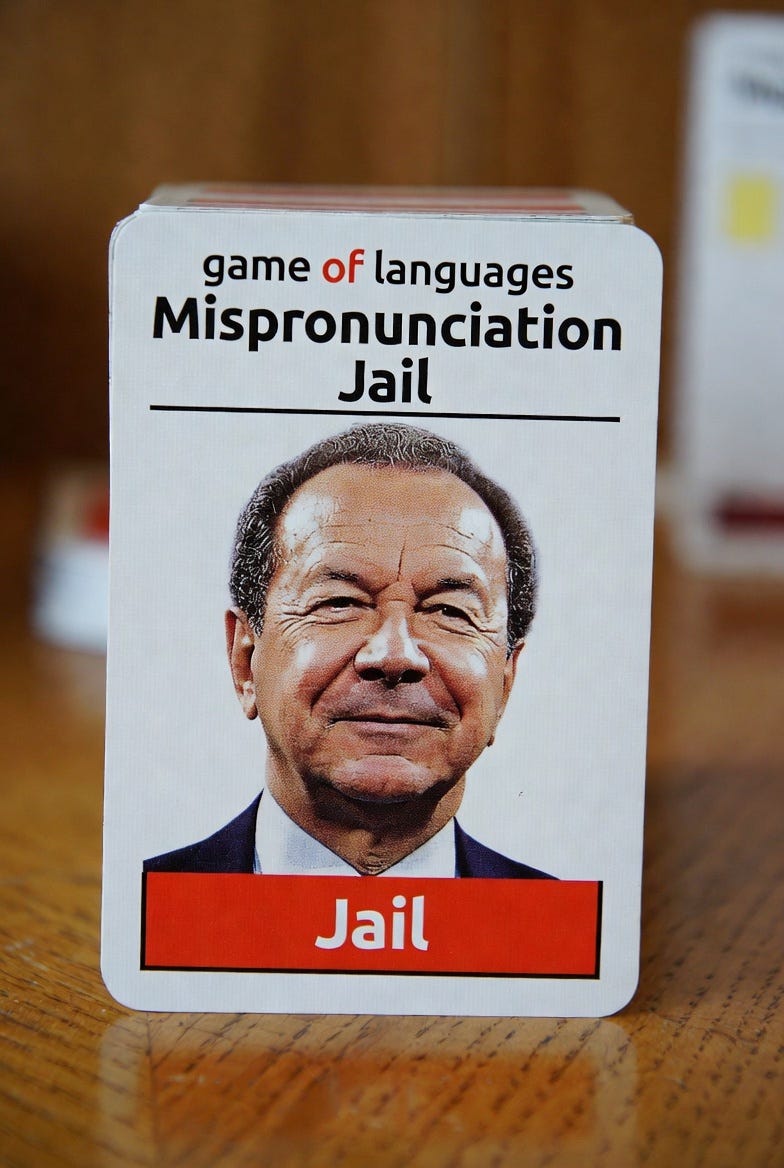
If you scored below, you have got the jail card!
7- Well done for your effort, you are more used to one language over the other perhaps from more exposure to its sounds or you have previously studied it. What will happen? Well for one of the languages you scored a 5 so you did quite well so this means only 2 months more in jail where you have to focus on the sounds.
4 - Well done for trying the game, you may have left language learning years ago or speak / are learning a very different language with distinct pronunciation. What will happen?You were caught trying to escape and sent back to jail for 4 months to focus on the linguistics of the languages or a language you choose to learn. If only your teacher had saved you by teaching with linguistics!
This game (no matter what score you got) demonstrates that an understanding of the sounds is needed in language learning:
French:
The /t/ is silent, the /er/ sound is different than that in English, the /ch/ in French appears more like the /sh/ in words like show / shoe / shop.
Lastly, the sound in rhythm differences e.g. in English, it is stress-timed (strong beats) vs in French it is syllable-timed (even, flowing).
Spanish:
The double /rr/ doesn’t exist in English and there is a silent /h/. Then we have words with a lot of vowels which can make it easier yet we meet the Syllable-timed rhythm again like that of French where Spanish is syllable-timed.
Now let’s dive deeper into how without linguistics in language teaching it can fail learners… 😮💨➡️😵💫
Learners Become Dependent, Not Independent 🪢🪜❌
Teaching without linguistics creates dependency. Students rely on teachers, textbooks, or apps to tell them what’s correct. They struggle to self-correct, analyze errors, or learn independently.
The aim of any teacher should be to create learners who become independent and take what they’ve learnt outside into the real world.
Linguistic awareness changes that. Learners begin to:
Decode unfamiliar sentences
Predict patterns in new vocabulary
Understand why errors happen
Transfer knowledge from one language to another
This is especially crucial for multilingual learners. Linguistics reveals connections between languages instead of treating each one as an isolated jungle of rules.
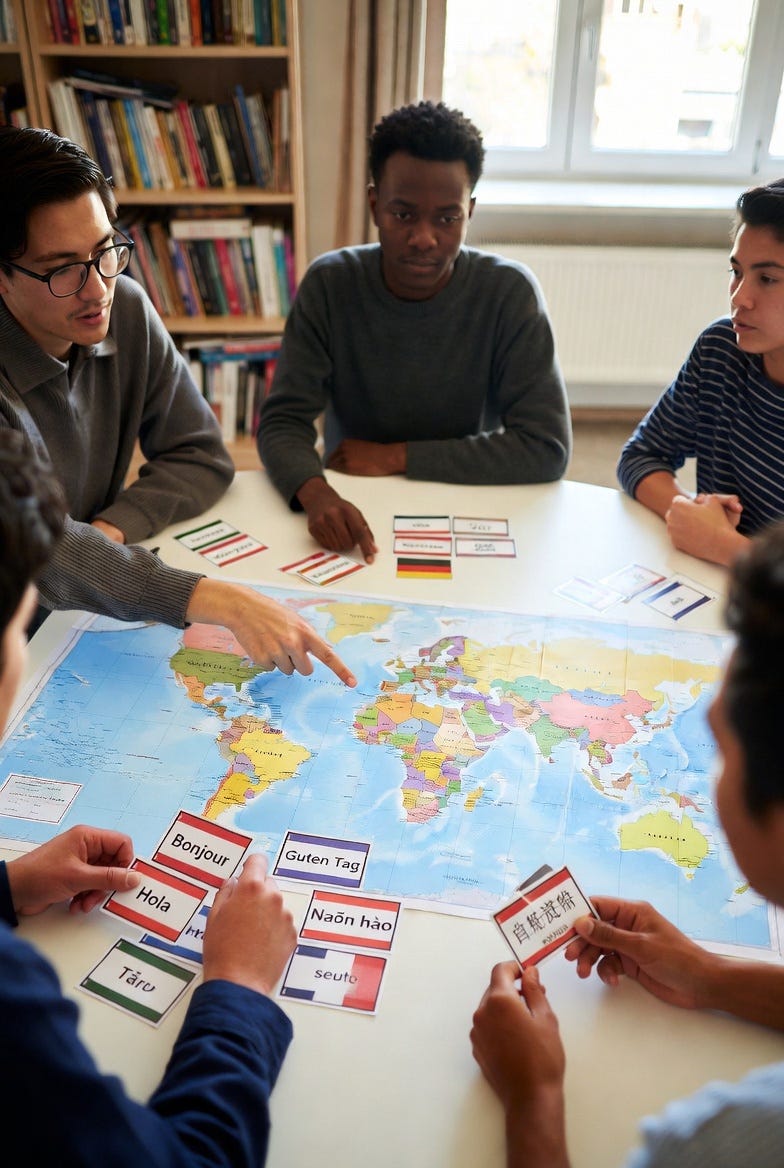
Real Communication Demands More Than Phrases
💬➕🧠➕🌍
Language is not a phrasebook. It’s a living system shaped by culture, power, identity, and context.
Pragmatics, discourse, and socio-linguistics explain why the same sentence can sound polite, rude, formal, sarcastic, or intimate, depending on how, when, and by whom it’s used.
When these dimensions are ignored, learners may speak ‘correctly’ yet still misunderstand or offend. They aren’t failing at language, they were never taught how language actually functions in the real world.
A real example of this was when my husband and I first moved to Spain, we were at our bank speaking to our Business banker about improvements in our business property as we have insurance via the bank for this.
My husband meant to say the word for kitchen “cocina” (ko-see-na) yet said the word “cochina” (ko-chee-na) after having had a confusing lesson with a Spanish teacher about sounds in Spanish (this teacher wasn’t good at on the spot questions and often fumbled and improvised, another story…).
Luckily our Business banker laughed it off and understood the context and corrected my husband as “cochina” - is an offensive word meaning -Disgusting person / dirty minded person.
Linguistics Is Not the Problem, Fear Is 😨🚫 → 🧠🔓
So why is linguistics often excluded? Because it’s seen as intimidating. Abstract. Academic. “Too much” for learners.
But this fear underestimates learners and oversimplifies linguistics. The goal is not terminology for its own sake.
The goal is clarity.
When linguistic concepts are taught gradually, practically, and meaningfully, they reduce confusion rather than create it.
Good teaching doesn’t avoid complexity, it manages it.
Now if you are teaching a proficient learner who solely wants to focus on practicing for an interview in the language and has fantastic knowledge of the sounds and when to use formal vs informal words etc. then linguistics will not be the sole focus.
But if you are teaching beginners or intermediate speakers who may get these elements wrong, it is the job of the teacher to focus on this area.
A Call to Rethink Language Teaching 🔄📘🌱
Teaching languages without linguistics is like teaching music without rhythm, art without perspective, or math without logic. You might get surface-level performance, but not mastery.
Learners deserve more than survival skills. They deserve understanding. Confidence. Agency.
Linguistics doesn’t replace communication, it explains it. And when learners finally see the system beneath the surface, language stops being a guessing game and becomes something they can truly own.
If we want fluent, flexible, and empowered language users, we must stop pretending linguistics is optional. It isn’t.
It’s the foundation.
Let’s rethink language teaching and learning, it’s never too late to improve, to flourish, to understand!
Thank you for reading!
𝓒 𝓢𝓲𝓶𝓸𝓷𝓮 ✨
Don’t be shy, leave your scores below in the comment section.
For any language teaching or learning tips feel free to:
Really enjoyed reading this, C Simone. I especially appreciate how you frame linguistics as something that explains communication rather than replaces it.
When I took that introductory course in Spanish, my teacher shared cultural and contextual insights, which I found really valuable — even though, as a learner, it sometimes felt overwhelming while I was still trying to remember the basic words and forms.
What you say about understanding the “why” behind language and how it clarifies communication makes a lot of sense. Your piece captures that deeper layer beautifully.
I’m curious — when I was attempting to learn Spanish, I often found myself translating in my head: “Here is an apple… okay, what’s that word in Spanish?” My brain would think in English first, then consciously search for the Spanish word. Once someone achieves fluency in a second or third language, as you have, how does that process change when switching between languages?
Finally, do you have a get out of jail free card? 😊
Oh damn it.. you got me I'm in mispronunciation jail lol. My score is too embarassing but who cares ey? I got 4 😂😂😂
Great article C, I enjoyed this and it was interactive and made me reflect! Right back to my lunch break! Keep it up!