
Teaching Languages Without Linguistics Fails Learners part 1
Memorization Creates Speakers, Linguistics Creates Thinkers


Last week I had a conversation with a former student Alessia, who I taught French to (as well as the primary curriculum) when she was in years 3 - 6 (she’s now 18!).
Her mum and I have kept in touch over the years, she often brightens my day with sending work Alessia found from her primary school days.
Our conversation really made me reflect on my own learning of foreign languages when I was at school.
Paid subscribers can listen to it here:
Let me take you back in time to the 90s ⏳📼💿
At the tail end of the mid-90s, I started secondary school, it was my first introduction to language learning in a school setting.
I had loved languages since a child, inspired by hearing different accents and dialects in my family, phrases rooted in a variety of cultures and our travels to visit family in different countries.
It was also influenced by the community of friends my parents had from all over the world and upon visiting my friends’ homes and hearing different languages such as Cantonese, Spanish, Turkish, Yoruba to name a few.
Due to our frequent visits to Spain, I wanted to continue learning Spanish at my new school, yet our year were taught French so I had to start right from scratch which was exciting for me!
However, despite the school producing good GCSE results in many subjects and having some brilliant teachers, it failed us with our language teachers.
Most of our teachers who taught French were terrible, and I mean really terrible at languages except one, Madame Delande.
The issue was we barely saw her throughout the first year, which was a shame as her lessons were so engaging, she brought languages to life.
In her place, we had a number of supply teachers who clearly had no clue as to what they were teaching.
Imagine teaching someone to drive without ever explaining how steering works. You could shout “turn left!” and “slow down!” often enough, and they might survive quiet streets. But the moment the road gets complex, traffic, rain, unfamiliar terrain, they stall.

That’s what happens when we teach languages without linguistics.
These supply teachers would usually turn up late, then shuffle around our teacher’s desk, introduce themselves and then ask us, “What are we doing today?”
Not only was this ridiculous, it was frustrating for those of us who actually wanted to learn French! We were constantly provided with worksheets displaying vocabulary we hadn’t learnt…
By the end of year 7, a huge portion of the class bunked French, they hid in the year 10 toilets which reeked of cigarette smoke, some sneaked into the teachers’ garden and others left the school building entirely venturing out to do all sorts!

Perhaps I was just a ‘goody two-shoes’ back then but I had this unfed desire to see Madam Delande back in our class, a teacher who knew about French and how to structure a fun lesson!
I can’t quite remember if the school informed our parents of the situation or if my complaints had surfaced at home, but my parents arranged for me to have a French tutor.
I wish I could thank Mr Mannion a million times! He opened up a whole new way of understanding the language, he taught with care, dedication and incredible knowledge.
He is the reason I survived the coming years of other teachers who couldn’t handle the class’ behaviour - the class clowns, consistent absentees plus the late comers who would enter shouting then hand out stolen sweets to everyone.
He is a huge part of the reason I saw an ‘A’ next to my GCSE result in French, continued to study French in college and after graduating, I decided to further my studies in French by completing a PGCE with Modern Foreign Languages.
Having a great teacher who inspires you, challenges you and believes in you is a gift! It can set the path to a fantastic career and many opportunities!P.S Having great parents who do the same is a treasure, thank you for all you did for us mi familia - Mark D and Christine Gordon 💓💓
The issue of language teaching ⚠️🗣️🧩
For decades, language classrooms have focused on what to say rather than how language actually works.
“Memorize this phrase. Repeat that pattern. Don’t ask why, just copy.”
At first, it looks effective. Students can greet, order coffee, maybe pass an exam.
But sooner or later, they hit a wall. And when they do, they don’t lack motivation or intelligence, they lack a map.
Fluency Without Understanding Is Fragile
Many learners know this feeling well. You study a language for years, yet simple variations confuse you. A sentence that “breaks the rules” freezes you. Native speakers talk fast, drop words, bend grammar and suddenly everything you learned feels useless.
One of our subscribers Ria wrote this in our Subscribers’ chat:
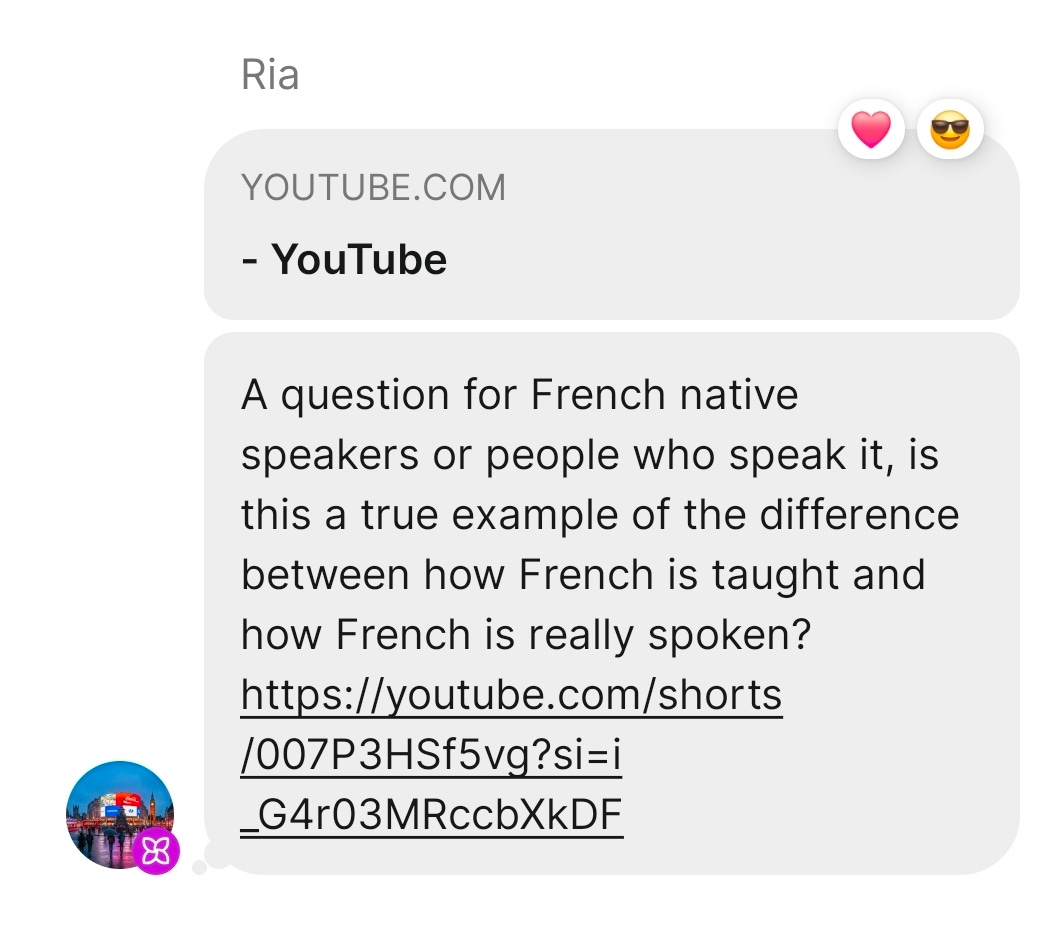
This question highlights the curiosity behind why there is a stark difference in how foreign languages are taught in comparison to how they actually work in everyday life.
Many of us were trained to imitate, not to understand.
Linguistics provides the underlying system: how sounds are formed, how meaning is structured, how sentences are built, and how context reshapes everything. Without this foundation, learners depend entirely on memorized chunks. Once those chunks fail, confidence collapses.
Understanding linguistics doesn’t mean turning every learner into a theoretician. It means giving them tools to reason about language, not just react to it.
Grammar Rules Are Not the Enemy, Bad Explanations Are 📝💥❌😕
There’s a popular myth in language teaching: “Grammar kills fluency.” So grammar is watered down, hidden, or avoided altogether. Learners are told to “feel what sounds right,” as if intuition magically appears in adulthood.
But intuition has its threads in patterns and these come from awareness.
When grammar is taught as arbitrary rules (“just because”), it feels oppressive. When it’s taught linguistically as a system that encodes meaning, it becomes empowering. Learners stop asking, “Is this right?” and start asking, “What am I trying to express?”
That shift is everything.
Pronunciation Sucks Most Without Linguistics 🗣️🎙️😖
I remember hearing how awful some teachers sounded when trying to speak French, it was laughable.
Now this is from the mind of a teen, when we are younger we don’t often think about the effort that is being made, we are more prone to judging what we like or dislike and my natural reaction was to laugh. It was a huge difference to how my tutor pronounced French words, he had such perfect pronunciation and having visited France, I often thought he could fit in as if he were a native speaker.
There’s a distinct difference between having one’s own accent and mispronunciation. Keeping an accent in my view is great, it expresses your identity, yet pronunciation expresses what you are aiming to communicate. Linguistics lends itself to accent reduction in cases where the phonetic sounds need to be transformed.
Here are some examples:
In Spanish, ‘Hola’ (hello) sounds like ‘ola’ as the /h/ is silent. The word ‘perro’ (dog) without the rolling of the /r/ will sound like ‘pero’ (but).
In French, the word ‘Salut’ (hi) sounds like ‘saloo’ as final consonants are often dropped, whereas in English we would pronounce the /t/ sound.
Nowhere is the damage clearer than in pronunciation. Many teachers rely on repetition alone: “Listen and repeat.” But if learners don’t know how sounds are physically produced, where the tongue is, how airflow works, what stress and intonation do, repetition just reinforces mistakes.
Phonetics and phonology are often dismissed as “too technical.” Yet phonics is taught in English in KS1 primary school to develop speech and reading. So why is this not applied throughout foreign language teaching?
Without them, learners struggle with certain sounds and how to improve intelligibility efficiently. They then blame themselves for something that was never properly taught.
Thanks for reading part 1!
Part 2 is coming soon where we will explore:
How learners become dependent and not independent
What real communication demands
What the real problem is and it’s not linguistics
A call to rethink language learning
See you in the next post!
𝓒 𝓢𝓲𝓶𝓸𝓷𝓮 ✨
Excellent piece, C. Simone! 😊
It seems clear that the quality of an instructor’s delivery—and their genuine care for student success—is critical when learning a language.
For the sake of argument, let’s assume all teachers are equally competent. If we’re talking about learning French, how well aligned are the curriculum, process, delivery, and scheduling from school board to school board, or from country to country? What has your experience been in that regard, and how critical are those program structures to overall student success? You also mentioned the growing number of apps and online resources on your podcast, which adds another interesting layer to this question.
I found the video clip especially interesting as well. What’s taught in the classroom often looks quite different from what’s actually spoken on the street—something that’s probably true of any language.
Finally, the idea of memorization versus understanding really stood out to me. In many ways, that principle feels universal. When I was delivering technical training, we used practical exercises—often on simulators—where students followed a series of steps to perform a calibration. The students who relied on memorizing steps tended to be weaker troubleshooters because they didn’t truly understand what they were doing. The students who understood what the process actually accomplished, on the other hand, could reason their way through problems. In essence, they knew—by analogy—that if the cake came out of the oven tasting sour, the missing ingredient was sugar.
Thanks for including my question and for your answer in the chat, you're a fabulous teacher.
You're right that linguistics are needed, that's why most of us Brits (and I imagine other people around the world) struggle with language learning when it's taught without it.
Keep up the great insightful work C 🧡